MOBILITY WEEK EVENT
PRESENTATIONS
Session 1: Sustainable Urban Mobility Initiatives and Best Practices in Europe and Western Balkans
This session presented European and regional best practices demonstrating how Sustainable Urban Mobility Planning (SUMP) can be translated into tangible urban transformations. Thepresentations highlighted successful experiences from Barcelona, the Netherlands and regional Western Balkan initiatives, illustrating how cities can reduce car dependency, improve publicspace quality and promote active mobility through integrated planning approaches.
- Barcelona’s urban decarbonisation strategy demonstrated how street redesign, pedestrianisation, green corridors and the Superblock concept can reclaim public space and reduce thedominance of private vehicles.Barcelona’s urban decarbonisation strategy demonstrated how street redesign, pedestrianisation, green corridors and the Superblock concept can reclaim public space and reduce thedominance of private vehicles.
- The Dutch Cycling Embassy presented cycling as a strategic mobility policy rather than solely an infrastructure intervention, emphasising network-based planning, safety, comfort, directness and accessibility.
- The Western Balkans Urban Mobility Initiative (WBUMI) showcased regional benchmarking, stakeholder engagement and investment prioritisation approaches supporting cities in developing evidence-based mobility strategies.
- Examples demonstrated the importance of integrating mobility planning with climate action, public health, urban regeneration and economic development objectives.
The session illustrated how SUMP principles can be implemented through integrated policy packages that combine infrastructure, governance and behavioural change measures. It highlighted the importance of long-term visioning, multimodal accessibility, active mobility promotion and the creation of people-centred public spaces. The presented case studies provided practical examples of how cities can achieve climate, accessibility and quality-of-life objectives through coordinated mobility planning.



Session 2: Sustainable Urban Mobility Initiatives in North Macedonia
This session focused on national-level efforts supporting sustainable urban mobility development in North Macedonia. Presentations addressed policy frameworks, institutional development, cycling promotion, strategic guidance and the integration of sustainable mobility into national transport objectives. The session demonstrated how national policies and capacity-building initiatives are creating an enabling environment for municipalities to develop and implement SUMPs.
- The White Paper on Sustainable Urban Mobility outlined a strategic framework for integrating sustainable mobility into national transport policy and urban development planning.
- National objectives include reducing greenhouse gas emissions, improving road safety and promoting modal shift through the preparation of Sustainable Urban Mobility Plans in municipalities.
- GIZ presented regional and national capacity-building activities, including SUMP training programmes, institutional support, advisory structures and municipal cooperation mechanisms established across the Western Balkans.
- New cycling infrastructure design guidelines were introduced to support the development of safe, coherent and high-quality cycling networks across North Macedonian cities.
- Presentations emphasised the need for institutionalisation of sustainable mobility through dedicated governance structures, revised regulations and enhanced cooperation between national and local authorities.
The session demonstrated how national policies, technical guidance and institutional frameworks can support local SUMP implementation. Particular emphasis was placed on capacity development, governance arrangements, active mobility promotion and the creation of enabling conditions for municipalities to adopt integrated and sustainable mobility planning approaches.


Session 3: Sustainable Urban Mobility Projects in North Macedonia
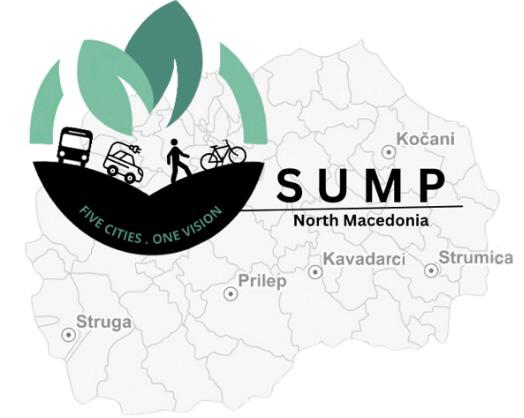
This session showcased practical implementation experiences from North Macedonia, focusing on the development of Sustainable Urban Mobility Plans for Kavadarci, Kochani, Prilep, Struga and Strumica. The presentations demonstrated how municipalities are translating SUMP principles into local strategies, actions and implementation frameworks.
- The five municipalities presented their SUMP development processes, including mobility diagnosis, vision development, objective setting and implementation planning.
- Local mobility challenges were analysed and translated into targeted policy measures supporting active mobility, public transport improvement, accessibility and sustainable urban development.
- Municipal representatives demonstrated how stakeholder engagement, public consultation and cross-sectoral cooperation were integrated into plan preparation and decision-making processes.
- The projects highlighted the importance of establishing a long-term mobility vision while identifying realistic and implementable measures tailored to local contexts and resources.
- The presentations collectively illustrated how SUMP methodology can be adapted to medium-sized cities facing different mobility challenges while maintaining a common strategic framework.
The session provided concrete examples of SUMP implementation in practice and demonstrated the transition from planning to action. The municipal experiences highlighted the importance of evidence-based decision-making, stakeholder participation, integrated governance and realistic implementation pathways. Together, the five city presentations showcased the emergence of a new generation of mobility planning practices in North Macedonia and contributed to strengthening the Community of Practice established through the SUMP programme.