What is Sustainable Urban Mobility Plan (SUMP)?

It is a strategic plan that was created to meet the mobility needs of individuals to improve the quality of life in the city. The purpose of the SUMP is to guide policies and planning for urban and metropolitan mobility in the medium and long term, with a 10-year horizon.
According to the European guidelines (Eltis guidelines) and European legislation, urban mobility planning includes a related set of actions that are developed and coordinated with the urban and environmental plans of the metropolitan area, to meet the mobility needs of those who live in the city, with the aim of “developing a new concept of plan capable of addressing the challenges and problems associated with transport in urban areas in a more sustainable and integrated way.
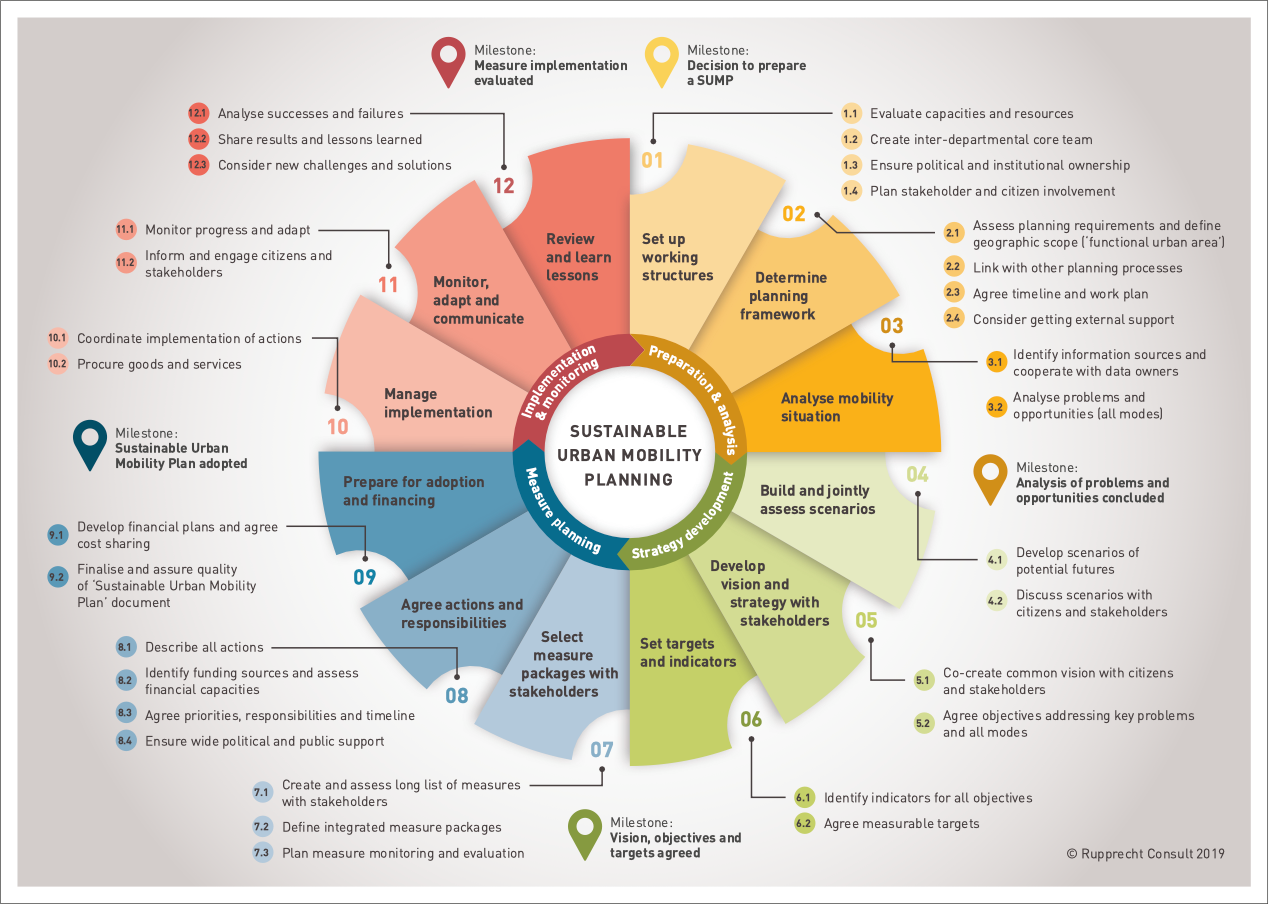
SUMP Cycle (Clock metaphor)
The SUMP introduces a fundamental innovation compared to previous plans: it puts people’s needs at the center rather than limiting itself to the management of car traffic alone. There are four general objectives that the legislation indicates as the cornerstones on which to develop a SUMP: – effectiveness and efficiency of the mobility system; – energy and environmental sustainability; – safety of road mobility; – socio-economic sustainability.
| Traditional Transport Planning | Sustainable Urban Mobility Planning |
|---|---|
| Focus on traffic | Focus on people |
| Primary objectives: Traffic flow capacity and speed |
Primary objectives: Accessibility and quality of life, including social equity, health and environmental quality, and economic viability |
| Mode-focused | Integrated development of all transport modes and shift towards sustainable mobility |
| Infrastructure as the main topic | Combination of intrastructure, market, regulation. information and promotion |
| Sectoral planning document | Planning document consistent with related policy areas |
| Short and medium-term delivery plan | Short and medium-term delivery plan embedded in a long-term vision and strategy |
| Covering an administrative area | Covering a functional urban area based on travel-to-work flows |
| Domain of traffic engineers | Interdisciplinary planning teams |
| Planning by experts | Planning with the involvement of stakeholders and citizens using a transparent and participatory approach |
| Limited impact assessment | Systematic evaluation of impacts to facilitate learning and improvement |